Is a General Power of Attorney (GPA) Sale Valid in India? The Law after Suraj Lamp
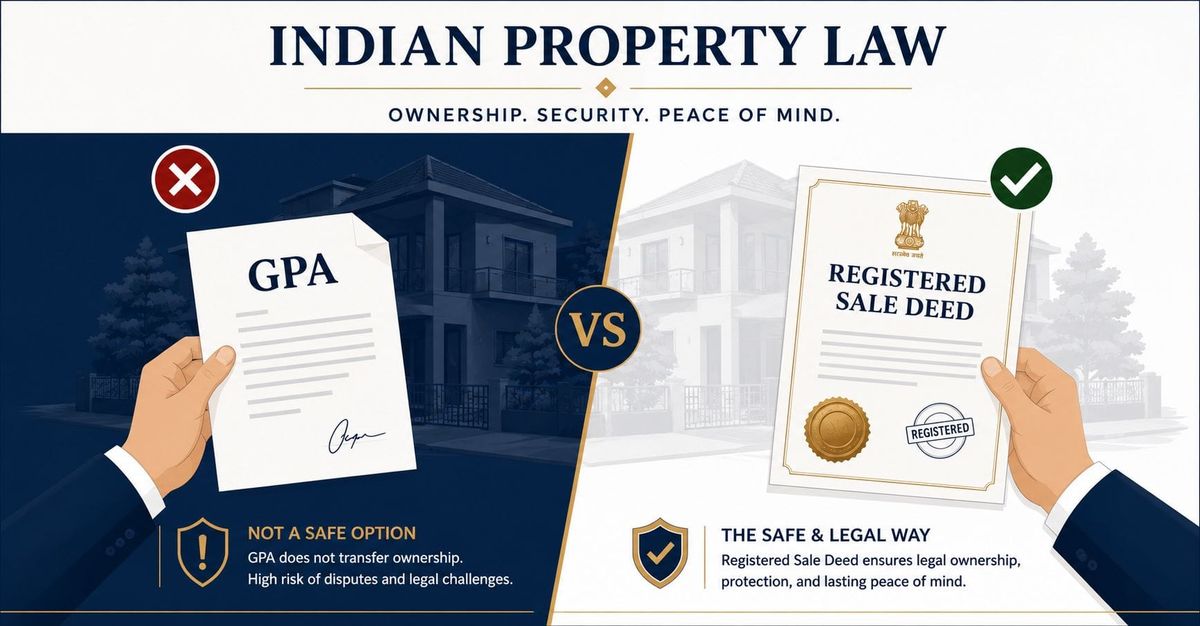
The Supreme Court held that a GPA, agreement to sell and will do not transfer property ownership. Only a registered sale deed passes title. Here's the law.

The Hon'ble Supreme Court’s Ruling: Suraj Lamp & Industries v. State of Haryana, (2012) 1 SCC 656
A three-judge bench of the Supreme Court (Raveendran, Patnaik and Gokhale, JJ.) held that a GPA sale, an agreement to sell, or a will (the common “GPA + Agreement to Sell + Will” package) does not transfer ownership of immovable property and only a registered sale deed (conveyance deed) transfers title.
Key points from the Suraj Lamp Judgment:
- A power of attorney is not an instrument of transfer. It only authorizes the attorney holder to act on behalf of the owner. It creates an agency, not ownership.
- An agreement to sell does not convey title. Under Section 54 of the Transfer of Property Act, 1882, a contract for sale of immovable property does not, by itself, create any interest in or charge on the property. Sale of immovable property worth ₹100 or more can only be made by a registered instrument.
- A will takes effect only on the death of the testator and can be revoked or replaced any time before that, so it provides no present ownership.
- Registration is mandatory under Section 17 of the Registration Act, 1908, and an unregistered document affecting immovable property cannot confer title (Section 49).
What this means practically for a buyer
- The buyer does not become the legal owner. The title stays with the original owner.
- Banks especially nationalised banks will not give loans against GPA properties.
- Reselling becomes difficult as the title still stays with the original owner.
- The GPA can be revoked by the executant and automatically lapses on his/her death.
Why people still do GPA deals, and the risk
GPA sales were historically done to avoid stamp duty, evade capital gains tax, or sidestep restrictions on transfer. The savings are illusory, as the buyer pays the full price for a potentially disputed title.
The only safe route:
Execute a Registered Sale Deed, with stamp duty paid, registration done at the office of the sub-registrar. Nothing less protects the buyer.